

Human Connections Get Things Done
February 2, 2026
Trabaho@Negosyo and The Path to Inclusive Growth
February 16, 2026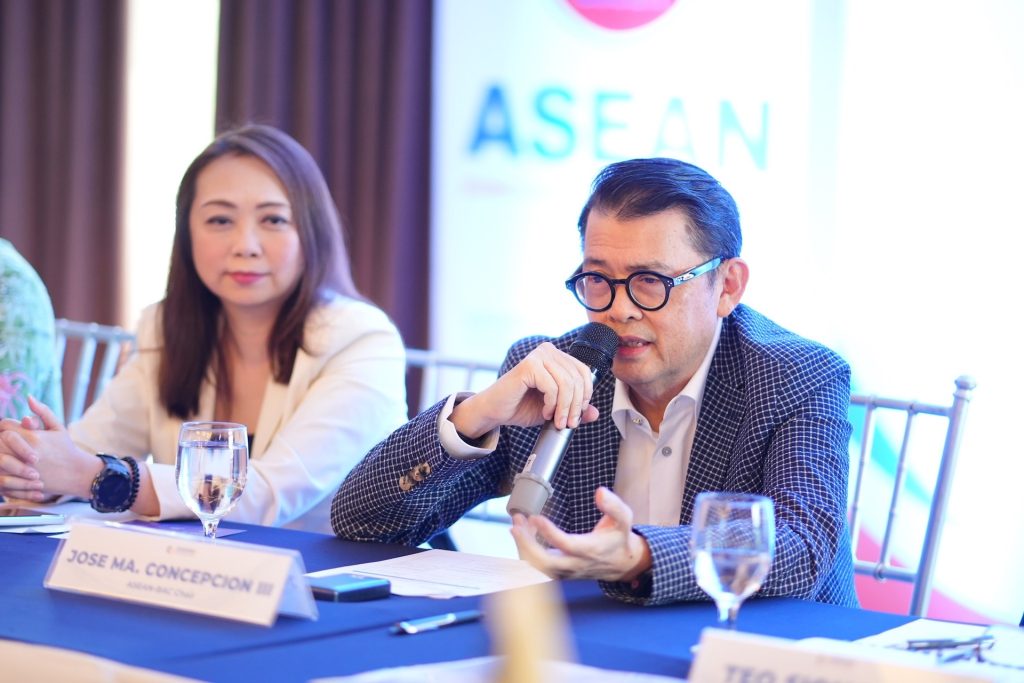


It was a productive weekend in Nasugbu. I brought the members of the ASEAN Business Advisory Council for our 105th meeting for a working weekend, followed by a much-deserved break in one of my favorite places in the Philippines. The fine food, singing, sailing and a round of golf in the scenic coasts of Batangas is just a preview of how the Philippines plans to put its best foot forward as host of ASEAN in 2026.
We were lucky to have had with us several of our allies in this work, including some of most respected think-tanks in the world, partners from outside the ASEAN in the Joint Business Council and resource persons from the ASEAN Secretariat. Our dialogue partners and organizations shared updates and their insights on current trade and investment conditions in ASEAN. For this, I thank the AustCham ASEAN, Canada-ASEAN Business Council, East Asia Business Council, EU-ASEAN Business Council, JETRO, ASEAN-New Zealand Business Council, Russia-ASEAN Business Council, UK-ASEAN Business Council, US-ASEAN Business Council, GMS Business Council, ASEAN Food and Beverage Alliance and the ASEAN Responsible and Inclusive Business Alliance for taking the time to join us.
This will be the first of many, many meetings this year to address priority issues and craft strategic recommendations for ASEAN leaders towards greater regional economic integration. The goal for 2026 is to ensure that the foundational participation of all 11 member-states leads to long-term legacy impact and inclusive growth for the 700 million people of the ASEAN community.
Time and again, we emphasize in our efforts the need for sustainability and inclusivity. In my work with Go Negosyo for the last two decades, helping those at the bottom of the pyramid, I can say that the two go hand in hand, and that given the interconnectedness and interdependency of countries, especially in a region like ASEAN, development must be sustained, and it must be inclusive. Consider that while ASEAN is home to some of the world’s strongest economies, there remains a wide gap with those on either end of the scale. Per-capita GDP ranges from $1,100 for our lower-income neighbors to $90,000 for our well-off ASEAN members.
Digital transformation, in particular, must be emphasized. While the region may not be the center of AI technology innovation, it is a large consumer of AI technology, particularly its IT/BPM sectors. It is also important to ground technology in real-world practices, thus the emphasis on our planned events in ASEAN-BAC such as hackathons, which we plan to mount for both amateurs and experts.
I am happy to share that the meetings last weekend saw us sign an MOU with the Tech For Good Institute. They are now our knowledge partner in the AI skilling and reskilling of the region’s workforce and MSMEs, and in strengthening the implementation of the Digital Economy Framework Agreement (DEFA), the region-wide binding agreement on digital governance that is expected to be rolled out very soon.
Another promising initiative presented during the meetings are projects for ASEAN women working with other ASEAN women, combining the best of what each country offers in terms of crafts and capitalizing on the creativity of each country. The Weaves and Waves event later this year should be a highlight of 2026. When it comes to women’s participation in the economy, the emphasis will be on moving from emancipation to elevation; that is, truly making women an essential part of the regional economy because they, like the youth segment, have yet to realize the full potential of their economic participation.
For the past two years, we have made headway with our agriculture and food security initiative, the ASEAN Food Security Alliance (AFSA). We plan to further elevate AFSA-related activities with each of the ASEAN member-states and mobilize more big-brother agriculture companies in the region toward more active collaboration. With a solid framework for AFSA now in the works, one built on public-private partnerships, technology transfer/adoption and a policy framework toward a unified agri ecosystem, this may yet be one of the biggest push towards greater agricultural productivity for the ASEAN.
Our focus on growing the region’s creative economies includes a proposal for an ASEAN Center of Excellence for Creative Industries, with a focus on areas like fashion and design, animation and film, and the performing arts. A great portion of the creative industries comprises what they call the “gig” economy, meaning freelancers who work outside of the formal setup or, at best, small outfits working on a per-project basis. To scale them up and help them compete, they will need access to finance, education and intellectual property protection.
The Philippines will be chair of the ASEAN-BAC in a very important year. For one, 2026 will be the 25th Anniversary of the ASEAN-BAC’s founding, and many historic events will be marked during the year: the 50th anniversary of the Treaty of Amity and Cooperation, the expected signing of the DEFA and the first year implementation of the ASEAN Economic Community (AEC)’s Strategic Plan 2026-2030.
For the first time, ASEAN-BAC will be an implementing partner for 67 specific activities, particularly in digital innovation, MSME development and the green economy. It will be a strategic partner, policy co-creator and private sector convenor in the implementation of the ASEAN economic integration agenda. Several ASEAN-BAC projects already align with the AEC deliverables, including the ASEAN Mentorship for Entrepreneurs Network, the Philippines’ legacy project from its last chairship in 2017.
Indeed, we are looking at a landmark year for ASEAN-BAC.
Originally Published in Philippine Star
Let’s get in touch.
We’d love to hear from you.
2/F RFM Corporate Center, Pioneer cor. Sheridan Sts. Mandaluyong City, Metro Manila, Philippines